



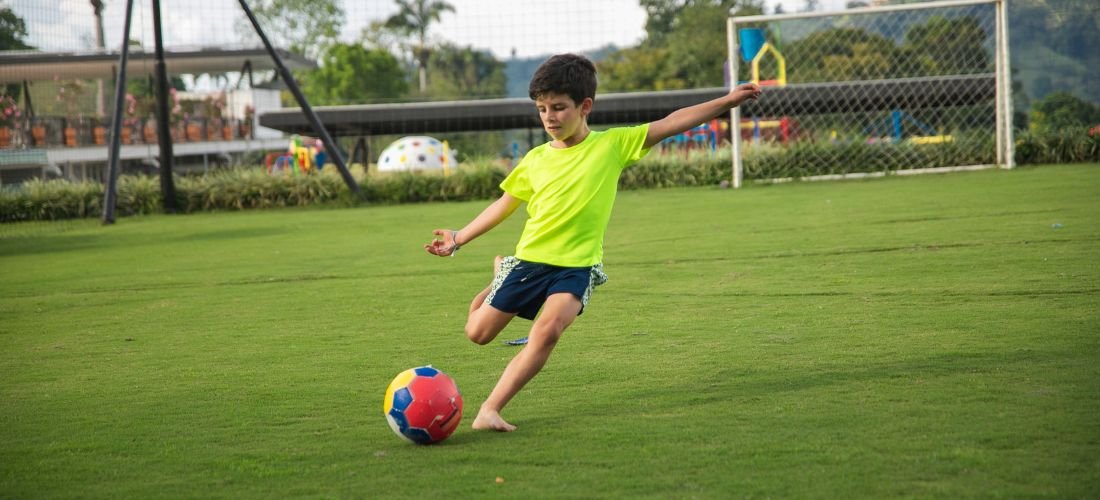
Why Sports Are Essential for Every Child’s Growth
The developmental brain, body and personality are rapid growing during childhood. Although school work builds children’s knowledge, sport also provides another form of learning. While the health benefits of sports to children are well documented, the positive impacts on their fitness are not the only areas of benefit to them; they can also support their fitness, confidence, social skills, emotional wellbeing and everyday habits, which they will carry into adulthood.
Children are spending more time sitting in the classroom or in front of screens in a world that has made more and more physical activity more important. Sports are important to children because not only are they a way to keep them active, but they provide them with a chance to cooperate, problem solve, challenge themselves and learn from success and failure.
Why Sports are important to children?
Children have opportunities to learn through action in sport. A child running around on a field to learn how to pass a football, practising a badminton shot or swimming across a pool is also learning skills which are not often taught in books.
Children and teenagers should be active at least 60 minutes every day, as recommended by the World Health Organization. It also suggests muscles and bones strengthening activities, at least 3 times a week. This daily activity can be made fun for children by playing sports and making them not just “exercising. They are learning the skills of play and competition, as well as exploring and making friends and are striving for small targets.
Sport is more than just physical activity
Many people have the wrong idea about children’s sports and believe it’s all about being stronger and faster.
In practice, development through the sport can be related to multiple areas:
- Body and co-ordination – balance, strength and control
- Confidence and self-esteem
- Communication and teamwork
- Discipline and responsibility
- Concentration and decision-making
- Emotional control
- Resilience and patience
- Leadership and problem-solving
This is because sports is not purely an after-school study activity but a crucial part of a child’s development also.
-
Sport makes our children’s bodies stronger
First and foremost, the greatest advantage of sports is fitness. Children’s muscles, bones, co-ordination, balance and endurance are developed through running, jumping, throwing, swimming, cycling, etc.
Exercise is also linked to a healthy heart and lungs, bone and muscle strength, healthy body composition and many others health benefits that last a lifetime.
Skills that the children can acquire physically
Children can achieve improvement in: (depending on sport)
- Balance
- Flexibility
- Speed
- Strength
- Agility
- Stamina
- Hand-eye coordination
- Body control
- Reaction time
These skills can help make daily living easier and help children feel more comfortable & confident in their body.
-
Sports support brain development
Children don’t shut their brain off when they go onto the field. Physical activity promotes better attention, memory, thinking, and other brain functions.
The CDC reports that physical activity improves children’s ability to focus and remember and is correlated with improved academic performance.
Children are also required to make decisions in a game very rapidly. Football player must choose to either pass or shoot. The player playing tennis must be able to read the other player. A basketball player is to choose a next location.
These little decisions will help children to see, act and think in stressful situations.
-
Sports have a positive effect on concentration
Children are sometimes able to focus and sit for extended periods of time when they have not been given enough opportunities to move.
Children burn their energy through regular physical exercise which is a healthy way to burn their energy. It also can help with concentration and recall and movement is a great component to a well-rounded school day.
This doesn’t imply that sport automatically means that all children get better marks. Rather, an active lifestyle can help support some physical and cognitive conditions that can facilitate children’s effective learning.
-
Physical Activity enhances Self Confidence
Imagine a child that cannot dribble a ball, the first time have him or her serve the ball on a tennis court or swim the entire length of the pool.
This little success can build a great self-confidence: “I can do this.
How playing sports helps a person become more confident
Children become confident through:
- Developing a new skill
- Practising in a situation where the skill is challenging
- Seeing gradual improvement
- Having coaches, parents and teammates that encourage them
- Making progress towards a personal goal
The American Academy of Pediatrics has found that children develop self-esteem and can learn numerous skills from sports such as goal setting, taking responsibility, controlling emotions, and sportsmanship.
The positive attitude that children may develop through sport can also influence their approach to tasks outside of sport.
-
Children learn how to collaborate as a team in sport
Team sports offer lessons which are not available in individual studies.
Children who play team games like football, basketball, cricket, hockey, volleyball or any other team game must learn to interact with others. They understand that their actions have an impact on the entire group and that they have a role to play.
Children learn to work cooperatively through teamwork to:
- Listen to others
- Communicate clearly
- Share responsibility
- Respect teammates
- Support others
- Follow rules
- Handle disagreements
- Celebrate group achievements
They can be helpful when completing projects in school and in friendships, workplaces and elsewhere.
-
Instruct children on how to deal with loss and winning
No one wins all of the games.
Losing a match may be depressing for a youngster. But it can be a learning experience—and a one to be enjoyed, with the proper assistance.
Children see through sports that mistakes and failures are normal. They can be helped to recognise the errors in their first attempt, repeat the same and come back with a different strategy.
What are the lessons that can be derived from losing?
- The art of taking a loss and disappointment
- To manage emotions and behaviour
- To respect opponents
- The ability to recognize errors made
- How to keep trying
- Appreciating improvement.
It is not the intent to cause kids to fear losing. It should be done so as to help them understand that one result is not an indication of their ability or value.
-
Sports promote discipline and good behaviour
Often improvements don’t occur after just one practice.
A child who is learning a sport (athletics, football, swimming, tennis, badminton or any other sport) must do the sport practice again. A really good lesson to learn: Consistency is a big factor that can get you a long way.
Children slowly come to realize the link between the effort and improvement. They also understand the importance of being punctual, to listen to instructions, to take care of equipment, to follow rules and to complete practice routines.
They can help them with other aspects of their lives as well.
-
Sports help children to learn social skills
Sports bring children together.
Children play with other school mates, coaches, opponents and with children of other schools/communities. These interactions enable them to practise in real-life situations.
Physical activity can reinforce social integration, as well as motor and self-esteem skills acquisition, cognition and wellbeing in children and youth, according to WHO.
But life is hard for the kids as well. Sometimes children become stressed when they are expected to study, take tests, play with friends, have expectations, and/or there is some change at home.
-
Sports Can Support Emotional Well-Being
Exercise can offer a healthy alternative. Physical activity helps maintain brain health, and is linked to decreased depression symptoms among children, according to the Centers for Disease Control and Prevention (CDC).
But the sporting ‘environment’ is important. Children should not be judged all the time; they need to feel supported. The American Academy of Paediatrics also suggests maintaining a positive and fun environment for kid’s sports without over-training and providing them an opportunity to burn out or become stressed.
-
Sports help improve communication skills
Communication isn’t all about “speaking with words.
In the game children develop their communication skills which are all demonstrated in the following ways: words, gestures, eye contact, movement and timing. They should communicate with their teammates what they are doing and be able to interpret what other teammates are trying to push.
For instance, a football player could signal for a pass, and a basketball player could call for a pass to the desired location. These small moments help children to learn how to communicate effectively and rapidly.
-
Sports Help Children learn Goal setting skills
Having a specific goal will motivate children to have something specific to work.
Here are some examples of possible goals:
- Running for 5 more minutes
- Using a new swimming stroke
- How to work on your serve
- Successfully passing 10 attempts
- Increasing flexibility
- Getting a better personal record taking part in a race
It is important to remember that the goal is reasonable and age and level appropriate.
In sports, the children are shown that it is typically good things that come in small steps that become great.
-
Sports can help to build leadership skills
The team leader may not be the team captain.
For a kid, being a good leader mean helping a teammate, explaining a drill to a new player, taking care of equipment, or being a calmed teammate.
These experiences can over time enable children to be more responsible and comfortable about decision making.
Sport can be used to promote leadership by:
- Taking responsibility
- Making decisions
- Supporting teammates
- Solving problems
- Being relaxed during stressful situations
- Encouraging others
- Accepting accountability
These are attributes that are useful in sporting endeavours and much more.
Concerning sport or study, do children have to make a choice?
At times, parents wonder about the time to be spent in sports and/or on studies. Instead, it is typically more effective to develop a balanced schedule instead of having a sport vs. academic’s priority list.
The CDC indicates that exercise can help your brain, your attention, your memory and your schoolwork.
You don’t have to be a competitive sports player to get these benefits from the child. Being active through regular play, PE class, cycling, swimming, running or through your favourite sport, can help contribute to an active lifestyle.
Developing a positive attitude toward sports with children to encourage them to play
Children are more likely to enjoy sports if adults make it a positive environment.
Parents should avoid the question “Did you win?” instead ask questions such as:
- Was the practice enjoyable?
- Let’s discuss about what you learned today.
- What was the most difficult thing?
- Have you acquired a new skill?
- For the next time what would you like to improve?
This takes focus away from outcomes and towards learning and progress.
Allow children to try out various sports
It is not possible for all children to enjoy the same activity.
A child can enjoy football, or prefer to enjoy swimming, badminton, athletics, skating, basketball or dance. Providing access to a variety of activities can enable children to work out what they really like!
The American Academy of Paediatrics is promoting the idea of encouraging children to try out sports and emphasize fun, not pressure.
Every school can make sports a larger part of the lives of their kids
The schools have a special role because at school they have the opportunity of providing physical activity to many children throughout the school week.
A good school sports programme need not only take its focus on the professional sportsman. It should also enable the students to find activities they enjoy, and provide opportunities for them to be involved at various levels of skills.
A child friendly sports programme may be made up of:
- Regular physical education
- Team sports
- Individual sports
- Athletics
- Swimming
- Fitness activities
- Recreational games
- Interschool competitions
- Safe and well-maintained sports facilities
Participation, learning, safety and enjoyment in addition to competition should be the focus.
The best sport for your child
No one sport is the best sport for all children.
The activity chosen will depend on the age of the child, interests, physical capabilities, personality, access to facilities and comfort level of the child. It can be beneficial to have a child participate in an activity they are not as shy about, such as an individual one, or one they are more comfortable with, like a team sport.
The parents should also think about the training environment and the coaches’ attitude towards them, whether they are supportive or not, and whether the training is age appropriate and safe.
Children can learn many valuable lessons from sports
| Area of Development | What Sports Can Help Children Learn |
| Physical | Strength, stamina, balance, coordination |
| Mental | Focus, decision-making, problem-solving |
| Emotional | Confidence, patience, resilience |
| Social | Teamwork, communication, friendship |
| Behavioural | Discipline, responsibility, respect |
| Leadership | Decision-making,accountability, encouragement |
| Technical assistance | Attention, memory and cognitive development |
The benefits child get from movement will differ from child to child but will be similar in most cases: movement can support multiple aspects of a child’s development simultaneously.
What if a Child is Not a Sports Person?
Active does not equal competitive sport.
Some children may not like matches but like to swim, ride a bike, skate, dance or jog, hike or play with friends or play. The objective is to develop a positive association with moving. If the child is anxious or unhappy about competing, parents and coaches can consider other competitive activities to try. Sports can be very beneficial but can become too competitive and become fun less.
If all that children see in their practices is about winning, they can develop this fear of failure in sports. Too much training can also lead to overuse injuries and burn-out, so the American Academy of Paediatrics says it’s important to balance the training of youth sports.
Good sports environments should enable children to develop and at the same time give them the opportunity to rest, study, play and enjoy other activities.
FAQs
Q1. What are the reasons why sports are important to children?
Ans. Sports are significant as they benefit not only physically, but also in other ways. Pupils will learn to communicate, team play, discipline, resilience, be confident and make decisions in activities that they enjoy.
Q2. Does playing sports aid a child to complete his/her homework?
Ans. The Centers for Disease Control and Prevention (CDC) recognize that physical activity positively impacts brain health, attention, memory and cognitive function, and among the benefits cited for physical activity in children is improved academic performance. However, don’t assume that sports are the only part of the pathway to higher grades – it’s more of a part of a comprehensive program.
Q3. What skills do children learn in sports?
Ans. Children get to learn how to work as a team, communicate, be disciplined, set goals, be leaders, make decisions, understand patience, responsibility and enjoy a sense of achievement as well as the ability to deal with failure. With the information provided a list of competencies being acquired cannot be given, the sport and environment will determine the skills acquired.
Q4. If my child is not interested in playing competitive sports what then?
Ans. Having to compete is not essential for a child’s development from physical activity. Encourage them to swim, cycle, dance, do athletics, play games, practice or play other sports until they are able to find something they really enjoy doing. The best is to have a good experience rather than forcing a child to do something he is not interested in doing.
Conclusion
Playing sports has more advantages than just on the field. Sports encourage children to exercise, that they build their confidence, communicate with others, that they think out solutions, that they get used to failing and that they acquire habits that will be useful to them in the future.
The significance of sport for children clearly becomes evident when considering the whole of the child’s development. A child is not a successful, self-reliant adult unless he or she has more to offer than the classroom curriculum. They also require movement and exploration, the opportunity to collaborate, to make errors, to set objectives and make another attempt.
This is the reason that sports are not to be considered a luxury after all children have done their “important” work. From football, to cricket, from badminton or tennis, basketball, swimming, athletics and outdoor play, being physically active is a cornerstone of a healthy and well-rounded childhood. It isn’t a matter of converting all children into professional athletes. It’s to make every child experience the fun of moving and provide them with physical, mental, social and emotional supports in their growth.
For schools and sport facilities that translates to providing environments that are safe, accessible and fun for children to learn, develop and participate at their own level.