


The Complete Beginner’s Guide to Tennis: Rules, Equipment, Skills & Tips
Starting a new sport can be hard, especially with a new set of rules, techniques, and equipment to understand. Fortunately, you don’t have to know much about tennis to get a game started. With a bit of practice, once you have mastered the game’s fundamentals, you will begin to enjoy playing the game and be able to play it for years after.
Learn all of the basics with a beginner’s guide to tennis, including tennis rules for beginners, tennis essentials, tennis playing, and why the best tennis coaching is offered to the beginner player.
If you’re just looking to have a bit of fun with friends, burn some calories or rip up a bit in the future, mastering the basics is just the right place to start!
What Is Tennis?
A game using a racquet played by 2 or 4 players. Participants play against one another at a net and attempt to make it hard for the other player to return the ball.
It’s easy: hit the ball into the right court off the scoreboard and find it in the right spot so your opponent can’t return it.
While professional tennis requires many advanced techniques and tactics, the basics are what will help the beginner start to enjoy the game!
Understanding the Tennis Court
The first rule of learning to play is to know the tennis court.
A tennis court is 23.77 metres (78 feet) in length. Singles are 8.23 metres (27 feet) wide, doubles are 10.97 metres (36 feet) wide. The net divides the playing area into two equal sides.
There are certain parts of a tennis court that are particularly important
The following is a list of court areas that every beginner should be familiar with:
- Baseline: The line across the back of each side of the court.
- Singles sidelines: The sidelines (side boundaries) used when playing a game of singles.
- Doubles sidelines: The wider boundary lines and bases for doubles.
- Service line: The line willing to assist in making service boxes.
- Service boxes: Locations in which a court serve must first touch.
- Centre mark: A small mark in the middle of each baseline.
- Net: Divides the two sides of the court.
Ball is “in” if it comes into contact with the boundary line during play.
The standard dimensions of a tennis court
| Court Feature | Measurement |
| Court length | 23.77 m / 78 ft |
| Singles width | 8.23 m / 27 ft |
| Doubles width | 10.97 m / 36 ft |
| Net height at centre | 0.914 m / 3 ft |
| Distance to service line from net (m / ft) | 6.40 / 21 ft |
Once you begin playing these markings are much easier to understand once you become familiar with the rules.
The list of tennis equipment every beginner needs
There’s no need to have a lot of high-priced machinery to get started in tennis. For the first lessons, all you need is a racket, appropriate balls, comfortable shoes and sports clothes.
-
Tennis Racket
The racket you get will play a significant part in your comfort during learning.
Beginners will use a racquet that has a large hitting surface and is easy to swing without undue effort.
When choosing a first racket, here are some factors you should take into account:
- Racket weight
- Head size
- Grip size
- Overall length
- String tension
- Your strength and comfort in play
Avoid buying the heaviest, or the most expensive racket because a pro one is a similar shape/feel. Select a material with which you are able to work comfortably.
-
Tennis Balls
Tennis balls are also an important component in your tennis equipment.
Slow rate balls can be helpful for players with limited experience or skill, or for beginners, to make rallies easier and build timing and control. Once skills are improved, it is then possible to move on to standard tennis balls.
-
Tennis Shoes
Traditional running shoes are not necessarily be best suited for tennis as it involves lots of side motion, fast stops and changes of direction.
Tennis shoes offer cushioning and support made for these actions and various surfaces of the court.
-
Comfortable Sports Clothing
Dress in porous clothing with “free-motion” on arms and legs.
Additional items for outdoor sessions:
- Cap or visor
- Sunscreen
- Water bottle
- Small towel
- Extra socks
In learning, it’s more important to be comfortable than being pretty.
How to play tennis as a beginner
Don’t be frightened of learning all the shots at once if you are wondering how to play tennis.
Start with the basics
There is one server on a point. Then the opponents return it and both teams play and play in unison until the player wins/loses the point.
Essential knowledge about Tennis Point Works
The simplest point is like to follow:
- The server is at the end of the base line.
- They are laid in the proper service compartment diagonally.
- The receiver returns the serve
- Both players hitting the ball over the net.
- The game continues until a player has made an illegal return.
Players usually take turns to serve following each game.
Illustrations clarify the tennis rule
Learning tennis will become easier if you breakdown the rules for beginners.
Points to remember are:
- Must serve diagonally into service box.
- A serve is usually double-taken upon by the server.
- Double fault is the result in case of both miss attempts and loss of the point.
- A ball may bounce once before returning control of the ball.
- Players can also send a ball back without letting it bounce, or “volley” it.
- Ball touching line is in.
- Players’ hands are not allowed to be on the net during play.
These rules will suffice to get a feel for basic games.
Understanding Tennis Scoring
The scoring most confuses most of them.
In Tennis, the regular game numbers are not 1, 2, 3 and 4, but rather:
| Points Won | Tennis Score |
| 0 | Love |
| 1 | 15 |
| 2 | 30 |
| 3 | 40 |
| 4 | Game* |
The player must have the required two-point margin.
Score of the server is given first
For example, A score of 30–15 means the server has won two points while the receiver has won one.
“Deuce” mean in Tennis?
The score is 40-40 when both players have 40. Points won between deuce are won when two consecutive points are won in a row. The first to win, “advantage”. Losing the next point brings the score back to deuce.
Games, Sets and Matches
Consider the scoring of Tennis to be three ranks:
Points 🡪 Games 🡪 Sets 🡪 Match
Players get points to win games and games to win sets.
Conventional scoring requires that a player win by a 2-game margin, but may vary based on the tournament employing modified scoring depending on tie breaks.
The tennis shots that are fundamental and important for beginners
For the beginner there is no need for the high-level shots.
Work on these 5 basic skills.
-
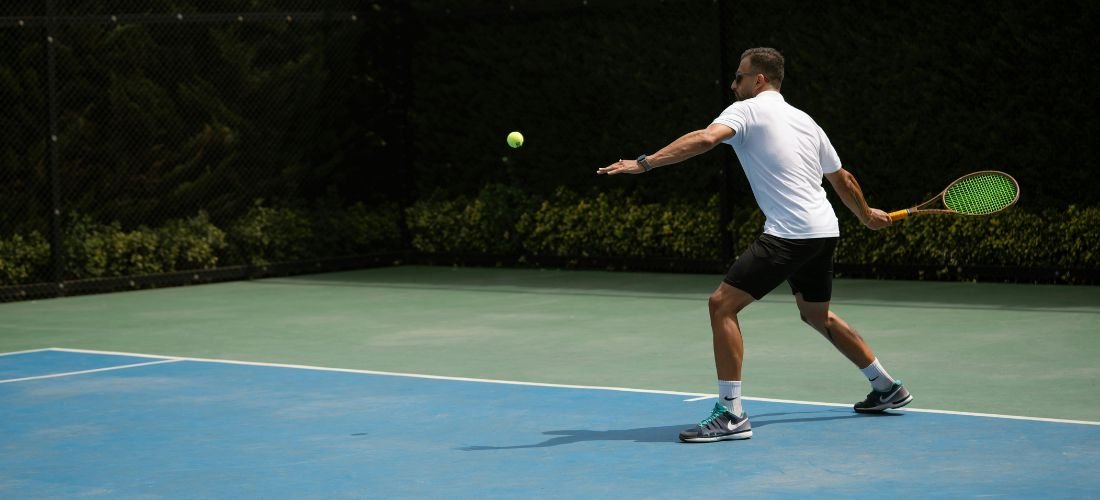
Forehand
Fore hand shot is the most common shot in tennis.
It is typically used on the right hand (righties) or left hand (lefties).
Emphasize control rather than power.
-
Backhand
Backhand is the shot that’s played across the body of your forehand.
Typically, players will choose one of the following:
- One-handed backhand
- Two-handed backhand
A two-handed backhand easier to perform smoothly for many people starting out with the backhand stroke.
-
Serve
All points serve as a “serve” and become one of the most crucial skills to learn.
As a novice, do not be concerned with serving very quickly.
Instead, focus on:
- Balance
- Ball toss
- Contact
- Direction
- Consistency
A greater number more closely in the box is going to help far more than trying to strike the ball hard as it is possible to.
-
Volley
Volley occurs when you miss the ball the first time.
The same instance in which they are close to the net, players are normally using volleys.
Basic volleys can be especially helpful as one begins to play doubles.
-
Overhead Smash
If the ball is thrown up high in the air, a smash over the head is performed.
In some ways similar to serving, but you’re striking a ball that is already moving.
Don’t rush to learn to perform big attacks. Maintain good positions and timing before you start.
Tennis Grip Basics
The way the racket interacts with ball is determined by your grip.
The method of gripping the equipment can vary based on level of expertise, playing style and type of shot.
There are several different types of tennis holds including:
- Continental grip
- Eastern grip
- Semi-Western grip
- Western grip
Continental is mostly used for serving, volley, overhead and slice and Eastern and Semi-Western are equally used for forehand.
Changing the grip too often and without understanding is something that should be avoided by beginners. You can develop a comfortable grip on each basic shot with the help of a coach.
Why Footwork is Important in Tennis
Often beginners are under the impression tennis is largely an arm game.
In fact, footwork can make it easier to hit the ball.
Rather than stretching an arm out to hit each ball, move feet to a comfortable hitting position.
Simple ways to improve your footwork as a beginner!
Try to:
- Keep your weight on the ball, not your legs.
- Bend your knees slightly.
- Don’t stand completely still.
- Make small adjustment moves around the ball.
- Go back to an after useful shot position after each shot.
- Observe your opponent’s when they are setting up to strike.
Raising the ball in time to make a controlled swing their aim should be to reach the ball in time to make a controlled swing.
Singles vs Doubles Tennis
Tennis may be games of singles or doubles.
Singles
Singles involve:
1 player vs 1 player
Singles sidelines are narrow – this is how wide the playing area is.
Players are allowed to play on the whole court in Singles.
Doubles
Doubles involve:
2 players vs 2 players
The longer doubles playing area is added to the court.
Communication and teamwork are very important, particularly as both players are responsible for covering the court.
There are different types of tennis court surfaces.
Some Tennis Courts are not the same.
Common surfaces include:
- Hard courts
- Clay courts
- Grass courts
- Artificial surfaces
Ball speed, bounce, ball movement and playing style can be impacted by court surfaces. The International Tennis Federation (ITF) has a system of surface classification that considers ITF speeds ranging from slow to fast.
If you are new, it’s more important to get comfortable with what surface you have to play and be regular in play.
If you are new to tennis, are you able to see the benefit of hiring a coach?
It’s possible to play tennis with other friends but it will be quite easy to use professional tennis coaching when you are beginners.
When mistakes become habits, they’re easy to spot only by a coach
Beginners sometimes have poor footwork as they do not realise it, stand too close to the ball, use poor grip and arm swing.
There are a number of advantages to Beginner Tennis Coaching
As a coach you can help to:
- Develop proper technique.
- Understand different grips.
- Improve footwork.
- Learn serving correctly.
- Build consistency.
- Understand match rules.
- Carry out structured drills.
- Reduce unnecessary mistakes.
Just a few beginner lessons will give an excellent basis to practice on independently.
If you are a new tennis player, then there are plenty of errors that you can easily commit
Errors are totally normalized during the learning of tennis.
But understanding typical issues can enable you to make quicker strides.
Take the initiative to try to hit EVERYTHING HARD!
Shouldn’t be the first item off their list is power.
Emphasize having ball in play, rallies.
Control first. Power later.
After bouncing, you’re standing still – congratulations!
NEVER stand at the ball and look what you did after you hit it.
Begin to prepare for the return of the opponent, right after playing it.
Ignoring Footwork
Even a good stroke can be tough to achieve if shot with poor stroke position.
When possible, step toward the ball paying attention to someone who is not reaching out to get to the ball.
Holding the Racket too tight
Many people tighten the racket as they believe it could have the power. Clutching can make the swing more difficult to make and can limit your motion.
Stay relaxed
Practice Without a Goal
Repeatedly hitting hundreds of balls isn’t necessarily an effective practice.
Provide purpose for each session.
For example:
- 15 minutes forehand
- 15 minutes backhand
- 15 minutes serving
- 15 minutes rally practice
Progression is more apparent when there is structured practice.
A Beginner’s Tennis Practice Routine Set – It’s Easy!
For a beginner, try out this beginner’s workout:
| Activity | Time |
| Warm-up | 5–10 minutes |
| Forehand practice | 10 minutes |
| Backhand practice | 10 minutes |
| Serve practice | 10 minutes |
| Footwork drills | 10 minutes |
| Rally practice | 15–20 minutes |
| Cool-down | 5 minutes |
You don’t have to follow these times exactly.
The aim here is to just play around and practice various aspects of your game, and not doing it for the entire length of a session.
How Long Does It Take to Learn Tennis?
Reference to a single solution.
Beginners can start to become comfortable rallying in a few lessons, some take longer.
You’ll gain points if:
- Practice frequency
- Coaching
- Fitness level
- Coordination
- Previous sporting experience
- Quality of practice
- Consistency
Don’t think about how fast you can get “good,” but on the contrary, concentrate on one minor aspect of what you’re trying to get good at.
Getting better, faster and easier as a beginner
The ‘improvement’ does not occur due to hitting thousands of balls in random sequence.
It happens as a result of ongoing, i.e., sustained, focused practice.
Follow these tips:
- Do many, many repetitions – not just a few!
- Concentrate on hitting the ball first before the distance.
- Quickly master footwork.
- Develop both forehand and backhand.
- Do a weekly service session.
- Use different opponents to play against.
- Avoid getting frustrated but learn from mistakes.
- Consider beginner coaching to correct technique.
Above all, have fun playing.
There should always be fun in tennis when learning.
FAQs
Q1. Does tennis require skill?
Ans. Controlling the racket, timing the ball, getting into position, serving the ball and knowing how to score the game are all a bit tricky for the beginning player. With a little practice, however, the basics of tennis are quite easy. Focus on keeping ball in play instead of trying advanced techniques – begin with simple ball play.
Q2. What are the fundamental rules of tennis?
Ans. The players shoot over the net to attempt to put the ball in the basket. It must be returned before an opponent receives his/her second bounce. The loser of the point is whatever happens to the player when he/she commits an error, such as an out of boundary, illegal return or double fault on serve.
Q3. What do you need to play tennis?
Ans. The beginner would only need a tennis racket, tennis balls, tennis shoes and tennis clothes that fits well and has to be near a tennis court. Water bottle, sun protection are other helpful items while playing outside.
For learning, you do not require any costly equipment.
Q4. Can you self-teach tennis?
Ans. Yes. Basic tennis is a skill that can be acquired by playing games with friends, practicing, instruction and playing regular games for beginners.
But if there are technique issues, professional coaching can detect them early and offer a guided practice and practice may be faster.
Conclusion
Learning tennis is not learning all the skills in your first couple of lessons. The basic strokes, base knowledge of the rules, selection of suitable tennis equipment and regular practice will produce a good base.
When considering tennis for beginners, remember that power is not the most significant factor compared to control and consistency. If your serve is not fast and the first rally is not long, you don’t have to worry. This is where all veteran players started.
Learn this beginner’s tennis guide, this basic tennis rules for beginner and start playing slowly to learn more about how to play tennis. If possible, choose tennis coaching for beginners to develop a proper approach from the beginning.
Most importantly, get on the court, keep on practising and enjoy it!