



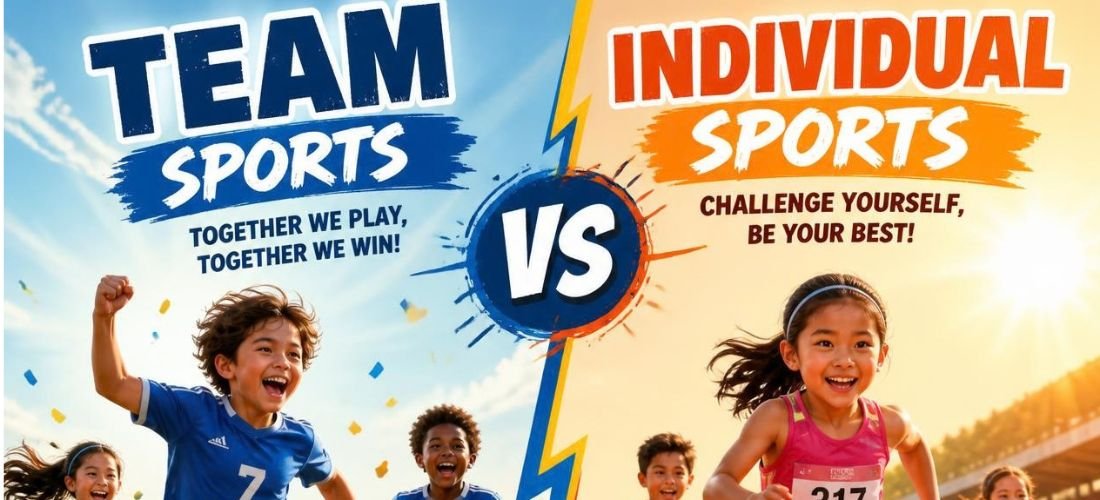
Individual vs Team Sports for Kids: Which Should Parents Choose?
Choosing a sport for your child can be harder than it sounds. With so many options available, parents often wonder whether they should choose an individual sport or a team sport for their child.
Should your child learn swimming, tennis, badminton or skating? Or would football, basketball or another team sport be a better choice?
The answer depends on your child’s interests, personality, age, goals and comfort level. Both individual and team sports can help children become more active while developing physical skills, discipline and confidence. The experience, however, can be quite different.
The good news is that parents do not always have to make a permanent choice between the two. Children can try different sports as they grow and gradually understand what they enjoy most.
In this guide, we will compare individual vs team sports for kids, explain the benefits of both, and share practical factors parents should consider before choosing a sports program.
What Are Individual Sports?
Individual sports are activities where a child mainly works on their own performance. The result depends largely on the player’s own skills, preparation and decisions.
Examples include:
- Swimming
- Tennis
- Badminton singles
- Skating
- Athletics
- Gymnastics
Although some individual sports can also have doubles, relay or team formats, much of the training still focuses on improving the individual athlete’s technique and performance.
For example, a child learning swimming may work on body position, breathing, strokes and endurance. A tennis player may focus on serving, footwork and shot control.
This type of training can give children plenty of opportunities to work on their own skills and track their personal progress.
What Are Team Sports?
Team sports involve players working together toward a common objective. Each player has a role, but success also depends on communication and cooperation between teammates.
Common examples include:
- Football
- Basketball
- Cricket
- Volleyball
- Hockey
- Relay-based athletics
In team sports, children learn that individual performance is only one part of the game. Passing the ball, communicating with teammates, understanding positions and making decisions during a match are equally important.
At Gallant Play, children can access coaching in several sports, while the multi-sport environment also gives families an opportunity to consider different activities based on their child’s interests and goals.
Individual vs Team Sports: Key Differences
Before choosing a sport, it helps to understand how the two types of activities differ.
| Factor | Individual Sports | Team Sports |
|---|---|---|
| Main focus | Personal development | Individual and team performance |
| Decision-making | Often independent | Shared with teammates |
| Social interaction | Can be moderate | Usually high |
| Competition | Against another player, time or score | Against another team |
| Training | Often skill-specific | Skills + teamwork + tactics |
| Responsibility | Mostly individual | Shared |
| Examples | Swimming, tennis, skating | Football, basketball, cricket |
| Progress | Easier to track individually | Depends on individual and team |
| Communication | Important but often limited | Central to gameplay |
| Environment | Personal or one-to-one | Group-based |
Neither category is automatically better for every child. The right choice depends on what your child enjoys and what you want them to gain from sports.
Benefits of Individual Sports for Kids
1. Children Learn to Take Personal Responsibility
Individual sports can teach children that their preparation and effort directly affect their performance.
If a young tennis player wants to improve their serve, for example, they need to practise the movement, listen to coaching feedback and repeat the skill.
This can help children understand the relationship between:
Practice → effort → improvement
That lesson can be useful beyond sports as well.
2. Personal Progress Can Be Easier to Track
Individual sports often provide clear ways to measure improvement.
A swimmer may improve their timing. A skater may learn a new movement. A tennis player may become more consistent with their serve.
These small improvements can give children a sense of achievement.
Instead of comparing themselves with another child, parents can encourage them to compare their current performance with their previous performance.
For young athletes, this can create a healthier approach to progress.
3. They Can Encourage Focus and Concentration
Individual sports often require children to concentrate on their own movement and technique.
For example, a badminton player needs to watch the shuttle, adjust their position and decide how to respond. A swimmer needs to maintain technique while managing breathing and pace.
Regular practice can help children become more comfortable with focusing on a task for a sustained period.
4. Children Can Develop Independence
In a team, players can depend on teammates during different moments of a match.
In an individual sport, the child may have to make more decisions independently.
They may need to decide how to approach a point, adjust their pace or respond to an opponent.
This can encourage independent thinking and responsibility.
5. Individual Sports Can Suit Children Who Prefer Smaller Groups
Not every child enjoys large groups.
Some children naturally prefer quieter environments, personal attention or working on a skill at their own pace.
For these children, activities such as swimming, tennis, badminton or skating may feel more comfortable.
That does not mean they cannot enjoy team sports later. It simply means their starting point may be different.
Benefits of Team Sports for Kids
1. Team Sports Teach Cooperation
One of the biggest differences between team and individual sports is the need to work with others.
A football player cannot win a match alone. Players need to pass, communicate, defend and support each other.
Basketball, cricket and other team activities create similar situations.
Children learn that different people can have different strengths and still contribute to the same goal.
2. They Develop Communication Skills
Team sports naturally create opportunities for children to communicate.
Players may need to:
- Call for a pass
- Give instructions
- Encourage teammates
- Discuss tactics
- Respond to a coach
- Communicate during a match
These interactions can help children become more comfortable communicating with others.
3. Team Sports Can Help Children Build Friendships
Regular training creates repeated opportunities for children to meet and interact with the same group.
Over time, teammates may become friends.
For some children, this social aspect is one of the biggest reasons they continue participating in sports.
A positive training environment can make children look forward to attending practice rather than seeing exercise as another obligation.
4. Children Learn About Roles and Responsibility
Every player has a role in a team.
A football defender, goalkeeper and striker have different responsibilities. In cricket, a batter, bowler and fielder contribute differently.
This teaches children that being part of a group does not mean everyone has to do the same thing.
Instead, each person can contribute in their own way.
5. Team Sports Teach Children How to Handle Different Results
Winning can be exciting, but losing is also part of competitive sport.
Team sports give children opportunities to experience both.
They can learn to celebrate respectfully, deal with disappointment, support teammates and return to training after a difficult match.
Parents can help by focusing on effort, learning and sportsmanship rather than only the final score.
Individual vs Team Sports: Which Is Better for Confidence?
Both can help build confidence, but they may do so differently.
In an individual sport, confidence can come from seeing personal improvement.
For example:
“I couldn’t swim this distance before, but now I can.”
That feeling of progress can be very motivating.
In a team sport, confidence can come from contributing to a group.
A child may feel proud after making an important pass, helping defend a goal or encouraging a teammate.
So the question isn’t simply whether individual or team sports build more confidence.
Instead, ask:
What type of environment helps your child feel comfortable, motivated and willing to keep learning?
What About a Child Who Is Shy?
Parents sometimes assume that a shy child should automatically start with an individual sport.
That is not necessarily the case.
A shy child may enjoy swimming or tennis because the environment feels less socially demanding. But another shy child may gradually become more confident through football or basketball because regular team interaction gives them opportunities to communicate.
The important factor is not forcing a child into an environment they strongly dislike.
A trial session can be useful. It allows parents and children to understand whether the coaching style, group size and sport feel comfortable.
What About Competitive Children?
Some children naturally enjoy competition.
They may want to keep score, beat their previous time or compete against another player.
Individual sports can provide a clear competitive structure.
Team sports can also be highly competitive, but children need to understand that their performance affects others.
For younger children, it can be useful to keep competition balanced with enjoyment and skill development.
The goal should be to help children enjoy the process of getting better rather than making every training session about winning.
Should Parents Choose Based on Personality?
Personality can be one factor, but it should not be the only one.
Instead of saying:
“My child is quiet, so they should play an individual sport.”
look at several factors together.
Consider:
Your child’s interests
What does your child actually want to try?
Interest is one of the strongest reasons a child may continue participating in a sport.
Their age
Younger children may benefit from trying different activities before focusing heavily on one sport.
Gallant Play’s existing multi-sport content also recommends exposing children to different sports during their early years and gradually considering specialization as they get older.
Their comfort level
Some children love large groups. Others prefer smaller training groups.
Their goals
Is the main objective fitness, recreation, skill development, competition or simply finding an enjoyable activity?
Schedule and convenience
A sport that fits comfortably into the family’s weekly routine is more likely to become a consistent habit.
Quality of coaching
A good coach can have a major influence on a child’s experience.
Parents should look for age-appropriate instruction, qualified coaches, suitable facilities and a positive training environment.
Can Kids Do Both Individual and Team Sports?
Yes.
Parents do not necessarily have to choose only one category.
A child could attend football coaching while also learning swimming. Another child might play basketball and practise tennis.
This approach can expose children to different movement patterns, environments and social experiences.
For example:
Football + Swimming
Can combine team interaction with an individual skill-based activity.
Basketball + Tennis
Can combine teamwork with individual technical development.
Cricket + Skating
Can provide team-based gameplay alongside balance and movement-focused practice.
A multi-sport approach can also help children understand which activities they genuinely enjoy before committing more seriously to one sport.
How to Choose the Right Sport for Your Child
Before enrolling your child, ask these questions.
1. What does my child enjoy?
Start with interest rather than forcing a particular sport.
2. Does my child prefer group activities?
If they enjoy working with friends, team sports may be worth trying.
3. Do they enjoy personal challenges?
Individual sports may appeal to children who enjoy working toward personal goals.
4. Is the coaching age-appropriate?
Training for a six-year-old should not simply be a smaller version of adult training.
5. Is the facility suitable?
Look at the playing surface, equipment, cleanliness, safety and overall environment.
6. Can my child attend consistently?
Regular participation matters more than choosing a sport that sounds impressive but is difficult to fit into the weekly schedule.
7. Can they try before committing?
A trial session can help a child understand whether they enjoy the sport and coaching environment.
Why Trying Different Sports Can Be a Good Starting Point
For many children, the first goal should not be finding their “perfect sport.”
It can simply be finding a sport they enjoy enough to keep playing.
Children’s interests can change. A child who loves football at seven may become interested in swimming or tennis a few years later.
Trying different sports gives them the opportunity to experience different activities before deciding where they want to focus.
Gallant Play operates a multi-sport ecosystem with coaching and Pay & Play facilities across Delhi NCR, including sports such as football, badminton, swimming, basketball, tennis and skating, depending on the location. (gallantplay.com)
This type of environment can be particularly useful for families whose children have different sporting interests.
Individual vs Team Sports: A Simple Decision Guide
Use this quick guide when discussing options with your child:
| If your child… | You could consider… |
|---|---|
| Enjoys working independently | Swimming, tennis, badminton, skating |
| Loves playing with friends | Football, basketball, cricket |
| Likes personal challenges | Tennis, swimming, skating |
| Enjoys communication and group activities | Football, basketball, cricket |
| Prefers clear personal goals | Swimming, tennis, badminton |
| Wants to be part of a team | Football, basketball, cricket |
| Is unsure what they enjoy | Try multiple sports |
| Wants both experiences | Combine individual + team sports |
Remember, these are starting points rather than fixed rules.
Common Mistakes Parents Should Avoid
Choosing a Sport Only Because It Is Popular
A popular sport may not necessarily be the right sport for your child.
Interest and enjoyment matter.
Focusing Only on Competition
Young children do not need every training session to revolve around winning.
Skills, confidence, enjoyment and consistency are also important.
Comparing Children
Every child develops at a different pace.
Comparing your child’s progress with another child’s performance can reduce enjoyment and confidence.
Starting With Too Much Training
More training does not automatically mean better development.
Children need time for school, rest, free play and other activities.
Ignoring What the Child Wants
Parents can guide the decision, but children should have a voice in choosing the activity.
If they genuinely dislike the sport, maintaining long-term participation can become difficult.
FAQs
1. Is individual sport better than team sport for kids?
Neither is universally better. Individual and team sports offer different experiences. Individual sports can encourage independence and personal skill development, while team sports provide opportunities to practise communication, cooperation and shared responsibility.
2. Which sports are individual sports for kids?
Swimming, tennis, badminton singles, skating and gymnastics are examples of sports that can involve primarily individual performance.
3. Which team sports are good for children?
Football, basketball, cricket and volleyball are examples of team sports. The best option depends on the child’s age, interests and training goals.
4. Can a child do both individual and team sports?
Yes. Children can participate in both types of sports if their schedule allows enough time for training, school, rest and other activities.
5. Should parents choose a sport based on a child’s personality?
Personality can be considered, but it should not be the only factor. Interest, age, goals, coaching environment, schedule and the child’s comfort should also be considered.
6. How can parents know which sport their child will enjoy?
Allowing children to try different sports can help. A trial class can also give parents and children a better idea of whether the sport, coach and training environment are a good fit.
7. What should parents look for in a sports academy?
Look for qualified and supportive coaches, age-appropriate training, suitable facilities, safe playing conditions, manageable batch sizes and a positive learning environment. Gallant Play’s coaching programs are designed for different ages and skill levels across its multi-sport locations.
Final Thoughts
Choosing between individual vs team sports for kids does not have to be a strict either-or decision.
Individual sports can give children opportunities to build personal discipline, focus, independence and technical skills. Team sports can help them practise communication, cooperation, responsibility and sportsmanship.
For many children, trying different activities is the easiest way to discover what they enjoy.
As a parent, focus less on finding the sport that sounds perfect on paper and more on finding an activity your child is willing to attend regularly, learn from and enjoy.
Whether your child is interested in football, basketball, swimming, badminton, tennis, skating or another activity, the right coaching environment can make the experience more positive and productive.
At Gallant Play, families can explore multiple sports and structured coaching options across Delhi NCR, with sports and facilities varying by location.
Ready to find a sport your child enjoys? Explore Gallant Play’s coaching options and choose an activity based on your child’s interests, age and goals.