



Swimming is one of the most complete body exercises and when you know how to swim the strokes then you can enjoy the water and also be sure you are safe, and are not afraid to go into the water. Professional training or just attending swimming classes in Greater Noida West, having knowledge on various swimming strokes is easy and enjoyable in learning. Stroke purposes, the difficulty level and health benefit are different in each.
In this guide, we are going to dissect 8 various styles and strokes of swimming using basic language. By the end you will know which stroke is good for beginners, the one which gives stamina and the one which is good in point of fitness or competition.
The Importance of Learning the Swimming Strokes Exercises
Training on various swimming styles is beneficial to gain increased confidence in the water and control of the body. The strokes employ the various muscle groups, which make you be a more solid and more balanced swimmer.
Beginners, particularly adults attending swimming classes are taught how to swim in steps. This keeps panic away and enhances the breathing process and enables the swimmers to take more time to swim but not even get too tired too soon.
. Freestyle (Front Crawl)
What Is Freestyle Swimming?
Freestyle is the swimming stroke which is most common and the fastest one. The first swimming lesson in Greater Noida West is typically taught since it is easy, effective, and very good as a workout.
During freestyle, you lie flat on your stomach, arms move at turns and legs are in constant motion. Inhalation occurs through turning the head sideways.
Why Freestyle Is the best one to start with
Freestyle is simple to master and instils stamina in a very short time. When you master perfected breathing, it comes natural and easy.
Key benefits of freestyle:
- Alleviates heart diseases
- Burns more calories
- Builds arm and leg strength
- Great in long distance swimming
. Backstroke
What Is Backstroke?
Backstroke– this is just like the freestyle but in a back stroke position. With beginners, your face stays above water and thus you can breathe more easily.
Backstroke is a more relaxed stroke with many beginners because there is no fear of water entering the nose or mouth.
Benefits of Backstroke
Backstroke enhances position and strengthens the back muscles. It is usually taught together with freestyle in beginner swimming exercises.
Reasons which may make learners love backstroke:
- Easy breathing
- Builds confidence
- Lessens pressure on the neck and the shoulders
- Great for relaxation
. Breaststroke
What Is Breaststroke?
Breaststroke is the oldest form of swimming strokes and is slower than the freestyle. It entails moving of both arms and legs in a frog-like motion.
This is a very popular stroke among recreational swimmers as breathing is easily performed and this stroke is easily controlled.
Why Breaststroke Is for Beginners
Breaststroke is most suitable when one wishes to swim slowly and not on a hurry. It is rather time based than speed based.
Key advantages:
- Easy to control pace
- Less tiring
- Good for joint mobility
- With fitness in long-distance swimming
. Butterfly Stroke
What Is the Butterfly Stroke?
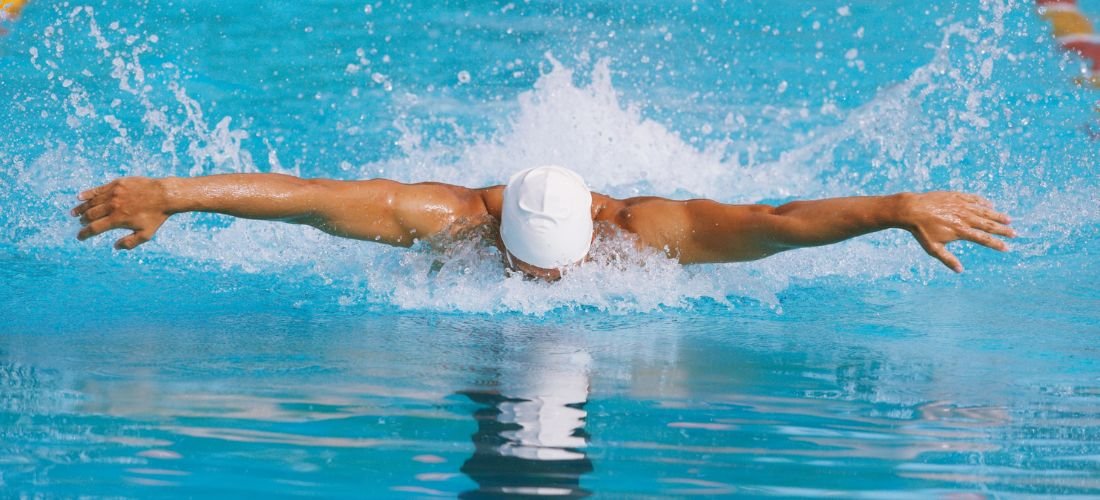
Butterfly is unique as it is not an easy swimming stroke. Its legs have a dolphin kick as both arms go along with it.
This stroke needs strength, coordination and correct way of breathing therefore it is normally learned after learning simple strokes.
Who Should Learn Butterfly?
Butterfly is suitable to high level swimmers and athletes. It acquires strength and stamina and is not advisable to a novice.
Main benefits:
- Builds upper-body strength
- Improves core stability
- High calorie burn
- The application in professional competitions
. Sidestroke
What Is Sidestroke?
Sidestroke is executed in a lying position on one side. It is widely applied in life saving and rescue swimming.
Sidestroke is, however, not applied in the competitions, but is very practical in safety training and survival swimming.
Why Sidestroke Is Useful
Sidestroke enables the swimmers to maintain their head on the surface of the water and move slowly without feeling fatigued.
Best uses of sidestroke:
- Lifesaving training
- Long-distance swimming
- Swimming with equipment
- Energy-efficient movement
. Elementary Backstroke
What Is Elementary Backstroke?
Elementary backstroke is a movement rhythmic stroke done in the back slowly and in a relaxed manner. It involves movements that are symmetrical in the legs and arms.
This is a stroke to which beginners, children and older adults are often trained since it is simple.
Benefits of Elementary Backstroke
It does not emphasize speed instead it emphasizes relaxation and breathing control.
Why it’s beginner-friendly:
- Very low effort
- Easy to breathe
- Improves water confidence
- Ideal for recovery swimming
. Dog Paddle
What Is Dog Paddle?
Dog paddle is a straightforward style of swimming; the arms and legs accompany like a dog swimming.
Even though it is not a professional stroke, this is the first stroke beginners tend to perform.
When Is Dog Paddle Useful?
Dog paddle assists beginners to be at ease in water, prior to being taught the techniques.
Advantages include:
- Easy to learn
- Builds initial confidence
- Useful in shallow water
- Healthy beginning of both children and adults
. Treading Water (Essential Survival Skill)
What Is Treading Water?
Treading water is never a form of forward movement, but a method of survivability in deep water.
It is also among the water safety skills that are taught during swimming classes.
Reason Treading Water Is Important
The skill would make swimmers rest, calm, and get out of emergency situations.
Key reasons to learn it:
- Prevents drowning
- Builds leg strength
- Essential for safety
- Applied in the case of water rescue
Comparison Table of Comparison Swimming Stroke
| Stroke Swimming | Level of difficulty | Best for |
| Free style | Easy Fitness | Beginners |
| Backstroke | Unchallenging | On confidence and stance |
| Butterfly | Hard | Competitive swimmers |
| Sidestroke | Moderate/safety | Safety/rescue |
| Elementary Backstroke | Easy | Beginners & seniors |
| Dog Paddle | Very Easy | The primary learners |
| Treading Water | Medium | Survival & safety |
How to select the best stroke when swimming
The swimming style is determined by your purpose. Any novice will most likely learn the freestyle and backstroke, whereas the fitness swimmers lean towards freestyle and breaststroke.
In case you are enrolling in swimming classes in Greater Noida West, you will be trained by instructors who will ensure that you can advance through the position of basic strokes to higher levels without any fear.
Conclusion:
The ability to swim various strokes leads to fitness, confidence and safety on the water. You do not have to become a master with all of them simultaneously. The fighting strokes used in swimming should be practiced straight and then one should learn this and then step-by-step build confidence.
It does not matter whether you are starting out or you are taking some classes in swimming in Greater Noida West; the thing is that you have to be consistent, and you have to be patient. All the swimmers have a place of beginning—and with proper strokes you will soon be at home in a swim.
FAQs
Q1. What is the easiest stroke to the beginners in swimming?
Ans. Out of the recently acquired swimming moves, the simplest one is the freestyle and the backstroke, as it is easy and breathing is less hectic.
Q2. How many strokes ought one to make when he or she is mastering how to swim?
Ans. It is recommended that novices should work with two to three strokes and the traditionally they are freestyle, backstroke and breaststroke.
Q3. What is the most calories burning swimming stroke?
Ans. Butterfly and then freestyle is at the top of the list of the highest energy burners since they use much energy.
Q4. Is swimming training in Greater Noida West suitable among adults?
Ans. There are a few virtual training programs of swimming at majority of the classes at Greater Noida West which are easy to use by adults when they have trained experts.
Q5. Is it essential to row all the strokes which must be learned?
Ans. No, it is not necessary. The crass moves will also be useful in achieving the necessary fitness, safety, and pleasure (3-4).
Q6. What is the minimum amount of time that you require to learn the fundamentals of swimming?
Ans. The novices carry out most of the strokes in 4-6 weeks of training.