



Which Sport Is Best for Fitness and Growth in Kids?
For parents, the question, “Which sport is the best sport for children?” is frequently asked. This will vary based on the child’s age, interests, fitness and objectives. Some of the best sports for kids offer the benefit of developing stamina, others are those that develop strength, flexibility, balance, coordination or teamwork. A variety of sport types and activities appropriate for the ages (general and physical development) may be more helpful.
Sports can benefit the health of children even if they aren’t kids who instantly become professional athletes. The primary target is to maximize their enjoyment of movement, build healthy habits and develop movement skills whilst remaining active in their childhood.
The importance of sport to children’s fitness and growth
This is a critical window of opportunity during childhood for promoting children’s movement skills, strength, coordination and healthy habits of movement. Sport can help to keep children physically fit and healthy, and it allows them to have opportunities to interact with others, play by rules, solve problems and have some confidence.
The World Health Organization suggests that children and adolescents (5-17 years) spend 60+ minutes a day in moderate to vigorous exercise. The activity should include at least 3 days per week of aerobic activity, and bone/challenge (strength) activity. What Does Fitness Mean for a Growing Child?
What Does Fitness Mean for a Growing Child?
Fitness involves more than just strength and speed in children. Contains a number of skills to assist children to move with ease and take part in everyday activities.
Important areas include:
- Stamina: Avoid fatigue easily – stay active
- Strength: Developing strong muscles
- Stability: Developing balance of core stabilizers.
- Bone health: Maintaining a healthy bone system involves physical exercise that’s compatible with the needs of bones.
- Flexibility: Moving joints through a useful range of motion
- Balance: The control of the body when standing and when moving,
- Coordination: Making different body parts work together
- Agility: Moving and changing direction quickly
- Fine motor skills: Mastering simple movements with the hands and feet, including throwing and catching balls, as well as running, jumping and catching
An excellent sports programme will provide the children with opportunities to be able to involve them in developing more than one of these skills.
What is the best sport for children?
Children’s interests, abilities, age and physical requirements vary from one another and there is no one-size-fits-all answer to which is the best sport for children. What’s exciting to one kid can be dull or uncomfortable to another sport.
Swimming, football, basketball, shooting, walking, cycling, badminton, tennis and skating are good general fitness exercises. Generally, the activity which is of a compatible age and ability level, and the one which the child enjoys, is the best choice.
The American Academy of Paediatrics also says that children should play a variety of sports and activities as they get older, instead of beginning to specialize in any one sport. By providing children with a variety, they can learn various movement skills, and may decrease issues with repetitive training.
Best Sports for Kids fitness and physical development
Various sports will offer various advantages. Instead of focussing on which sport the child is best, parents can focus on what type of development the child is seeking as well as on what sport he/she enjoys.
-
Swimming as a whole-body exercise activity
In swimming, children must synchronically act their arms, legs and core with the breathing. It can help develop endurance, coordination and confidence and flexibility in the water.
A fun-loving swimmer’s objective is not simply fitness, but also safety in the water. The American Academy of Paediatrics’ water-safety preparation guidelines say that swimming instruction is a critical component and that many children can take formal swimming lessons at about age 4, depending on water safety conditions and children’s development and readiness.
Swimming is an activity that develops:
- Cardiovascular endurance
- Coordination
- Flexibility
- Body control
- Muscular endurance
- Water confidence
This is also helpful for kids that prefer solo games over group playing.
-
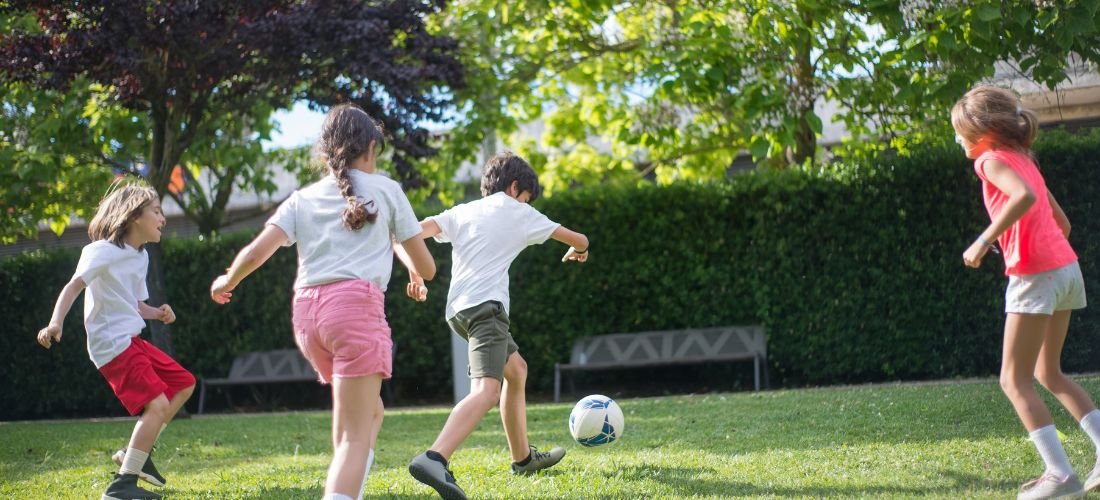
Football: Fitness, Speed, and Teamwork
Football is a highly involved team activity for kids. During a match players walk, jog, run, change direction, kick and react to other players the majority of the time.
With the quick changes of the game, children also get practised in decision making and team work. Football can then be a way to have some physical activity, communication skills and social skills.
Football can work on developing:
- Stamina
- Speed
- Agility
- Balance
- Coordination
- Leg strength
- Teamwork
- Decision-making
Younger children should concentrate on enjoyment, activity, basic skills and on playing age appropriate games not competition.
-
Basketball: Agility and Co-ordination
Running, jumping, cutting, dribbling, passing and shooting are the skills used in the game of basketball. These activities support the child’s balance, coordination and promote the movement of the children physically.
The sport can also build the skills and abilities in making one decision that a kid can make. They will need to observe other players and competitors, assess their own and others’ skills and abilities and be able to pass, shoot and react in games.
Basketball can support:
- Agility
- Coordination
- Jumping ability
- Stamina
- Balance
- Hand-eye coordination
- Teamwork
This is particularly entertaining for children who like action games and team play.
-
Athletics: Building Basic Movement Skills
Athletics involves a myriad of events including running, jumping and throwing. The reason why these movements are useful is that they are basic movements used in a number of sports.
Efficient running, jump and throwing skills translate to a team sport like football, basketball, cricket, tennis and more.
Athletics can develop:
- Running technique
- Speed
- Endurance
- Jumping ability
- Coordination
- Body control
- Explosive movement
Athletics can also be modified for age and ability, and may be an option for activities that little kids love challenges.
-
Badminton: Speed, Balance and Reaction Time
While the game of badminton may seem to be easy to follow, children are required to move around quickly and be able to follow a shuttle that moves at a quick speed.
Players must coordinate the use of their eyes, hands, feet and body. Footwork, balance, reaction time, agility and hand-eye coordination can be improved through practice. Can be played either in singles or doubles; children can have single game play or team privileges.
Badminton will aid to enhance:
- Reaction speed
- Footwork
- Balance
- Agility
- Hand-eye coordination
- Flexibility
- Concentration
In the country-side parts of the world, where outdoor sports might not be well suited because of the weather conditions, indoor badminton can be an option too.
-
Tennis: Coordination and Movement
Tennis is a sport that requires a variety of skill sets including running, changing direction, hitting, serving and strategic thinking. Kids must make decisions on where that ball is going and move accordingly to the ball’s path.
Can develop hand-eye coordination, and it may be bell aerobic. The sport becomes more appropriate for younger people when there are modified courts and lighter racquets, and softer balls are used.
Tennis can support:
- Coordination
- Agility
- Balance
- Reaction time
- Stamina
- Concentration
- Movement control
-
Cycling: Endurance and Leg Strength
For children, there are also fun activities such as cycling that maintain their physical activity. It can offer cardio and exercise lower leg muscles.
It also provides the children with an opportunity to go outside and play. Helmets need to be correctly fitted and children must be actively practicing in appropriate and safe environments.
Cycling can develop:
- Leg endurance
- Cardiovascular fitness
- Balance
- Coordination
- Stamina
There’s no need to be competitive in cycling. Family cycling can just be a component of an active lifestyle.
-
Skating: Balance and Body Control
Children need to be able to stay balanced when they are skating across a surface. They must have control of their direction, speed, body position and legs.
With regular practice, balance, coordination, agility and the control of the lower part of the body can be enhanced. Falls can happen during learning so falls safety equipment, and appropriate coaching, is particularly significant.
Skating can foster the development of:
- Balance
- Coordination
- Agility
- Leg strength
- Body control
- Confidence
Best Sports for Different Fitness Goals
Rather than seeking the sport to solve all of their sporting problems, parents can make a comparison between sports based on parents’ desired skills for their child to obtain.
| Fitness or Development Goal | Sports to Consider |
| Stamina | Swimming, football, cycling, athletics |
| Coordination | Badminton, tennis, basketball, swimming |
| Balance | Skating, gymnastics, cycling |
| Agility | Football, basketball, badminton, tennis |
| Strength | Swimming, gymnastics, climbing, athletics |
| Teamwork | Football, basketball, hockey, volleyball |
| Flexibility | Swimming, gymnastics, skating |
| Reaction time | Badminton, tennis, basketball |
| Running ability | Athletics, football, basketball |
| Water confidence | Swimming |
| Overall movement skills | Athletics, swimming, football, multi-sport activities |
This table should not be considered a ranking. Many sports require a number of skills and their gains rely on the frequency of participation, the kind of coaching that is provided, and whether the sport is age appropriate.
Does multi-sport training work better for children?
Trying out other sports may be more beneficial for many young children than selecting a particular sport and practicing the sport all year long. The various play activities involve other movements, other muscles so that the children have a wider base of physical skills.
Early specialisation is not recommended by the American Academy of Paediatrics as the repetitive training in one sport can increase the risk for overuse injuries. Children can gain from engaging in various sports and adequate rest/recovery time.
What can a multi-Sport week be like?
A week of activities or a basic week could consist of a different activity in place of the same sport each day.
For example:
- Monday: Football practice
- Tuesday: Cycling or outdoor play
- Wednesday: Swimming
- Thursday: Rest or light activity
- Friday: Badminton
- Saturday: Football, or basketball
- Sunday: Family walk, cycling, or free play
The specific length of time will be dependent upon a child’s age, school schedule, fitness, training level and recovery requirements. The goal is to have activities that happen frequently but not create an overwhelming full-time load of sports for kids.
How to select a sport for your-child?
Selecting the proper sport goes beyond being merely physical advantages. Children who like an activity will be more likely to attend on a regular basis.
Priories Child’s Interest
Start the conversation with an open question: Do you like? What activity are you interested in? An activity that you like? Some children enjoy team sports, others prefer to swim, skate, participate in athletics or play individual racquetball sports.
Don’t pick a sport just because it’s in style or it’s being done by other kids. Long-term involvement can be quite impacted by interest.
Take account of the issues faced by age and development
Children’s physical abilities do not develop equally. Sports programmes to follow age-appropriate rules and equipment, training levels and expectations.
Think about any of the following abilities when selecting a sport for a child: age, physical abilities, intellectual development and preparedness.
Inspect Coaching Environment
As a good coach, the first thing you want to do is to get children to learn a skill safely and make the session enjoyable. Young players will simply need to be encouraged and to develop their skills, not put under pressure to win all the games.
Pre-assessment is available for parents before they join an academy to view:
- Coach experience with children
- Safety arrangements
- Quality of sports equipment
- Playing surface
- Class size
- Age-based training
- The warm-up and cool down exercises
- Ambitious attitude towards competition
Safety and recovery
Children need some time to recuperate. Do not over-train a child so that they are always tired, in pain or losing interest.
According to the AAP, burned out and overuse injuries can be caused by training children too hard without giving them due rest, nor allowing enough variation in activities.
The amount of exercise children should get differs from person to person
CDC’s guidance for children and adolescents (6–17 years) is to engage in moderate to vigorous physical activity at least 60 minutes a day. Majority of this activity should be aerobic, and there should be vigorous (muscle strengthening) and bone strengthening (500) activities at least 3 days a week.
This activity may be part of structured sports or through active play and normal activity. The child does not have to complete the 60 minutes in formal coaching.
The CDC has been recommending that children ages 3-5 aim for daily physical activity instead of the 60-minute guideline for 6–8-year-olds and older.
List of common mistakes to avoid
Parents have the best interests of their children in mind, but too much pressure and fun is lost during sporting events.
- Do not make these common errors:
- Choosing a sport only because it is popular
- Not force to continue a sport they strongly dislike
- Comparing children to one another
- Single-mindedness about winning
- Training for several hours on a daily basis
- Ignoring pain or persistent tiredness
- Specialising too early
- Forgetting rest days
- Use of adult equipment for children too young to use properly
- Making all training sessions competitions
The focus should be to develop good attitudes towards physical activity during childhood years. As children get older and more experienced, they may naturally have competitive goals.
FAQs
Q1. What’s the best sport for kids?
Ans. There are no rights and wrongs when it comes to what the ‘best’ sport is for any child. Other sports including swimming, football, basketball, athletics, badminton, tennis, cycling and skating can be used to develop different elements of fitness and growth. The preferred one would vary in accordance with the child’s age, interest, skills, safety, and fun.
Q2. What is the sport that kids’ health should exercise?
Ans. Sports that incorporate frequent, entire body movements, for example, swimming, football, basketball and athletics can yield sound fitness advantages. Adding variety, however, allows children to obtain a wider variety of physical skills than by participating in a single sport.
Q3. Are children who swim at a higher fitness and growth level?
Ans. Yes. Swimming offers children whole-body movement, and can be used to develop their endurance, coordination, flexibility and control over their bodies. It also provides valuable water safety training. Swimming lessons are part of water safety programs for children, according to the American Academy of Paediatrics.
Q4. Is there a reason against kids playing more than one sport?
Ans. Yes for a lot of kids. Choosing other sports to play may help to build a weightier base of movement skills while helping to minimise repetitive demands on the early specialiser. The AAP emphasizes that children should experience a variety of activities and should not specialize too quickly, especially in one activity, throughout the entire year.
Q5. What are the optimal amounts of time for children to play sports?
Ans. The specific number of organized sports hours is not applicable to all children. The CDC suggests for kids ages 6 to 17 that they get at least 60 minutes of moderate and vigorous physical activity a day, including aerobic, muscle-strengthening and bone-strengthening exercise, in total.
Conclusion
So, what makes for the best sport for a child? It depends on the context and there is no quick and easy answer. These include building Water confidence and Fitness, general fitness and health, agility and co-ordination, whole body fitness and agility.
The main target for younger kids should be regular movement and fun, developing skills, and practicing various sports, instead of engaging in a single sport and training hard all year long. Children can build a foundation for a wide range of sports by combining a range of sports and active play and making it fun.
Use activities that are appropriate for their child’s age, interests, abilities, comfort. By bringing supportive coaching, appropriate facilities, adequate rest and a positive environment to the table, kids’ sports can transform from mere workouts to more than just a healthy lifestyle building experience for kids that continue as they mature.